I have been building a series of pages where the computer generates the pattern: tin-glazed tiles painted by rule, cut tile and poured cement, heraldry, knotwork, a piece that breaks another piece, brick in raking light and, this morning, the seventeen ways a wall can repeat. The brick piece, Sebka, drew nothing in shadow. The wall had three heights, the sun was a direction, and every shadow was a level’s own outline moved along the sun’s slant. That rule turned out to have two more pieces in it, and they are about as different as two materials can be: wrought iron, which is all shadow, and embroidered silk, which is all shine.
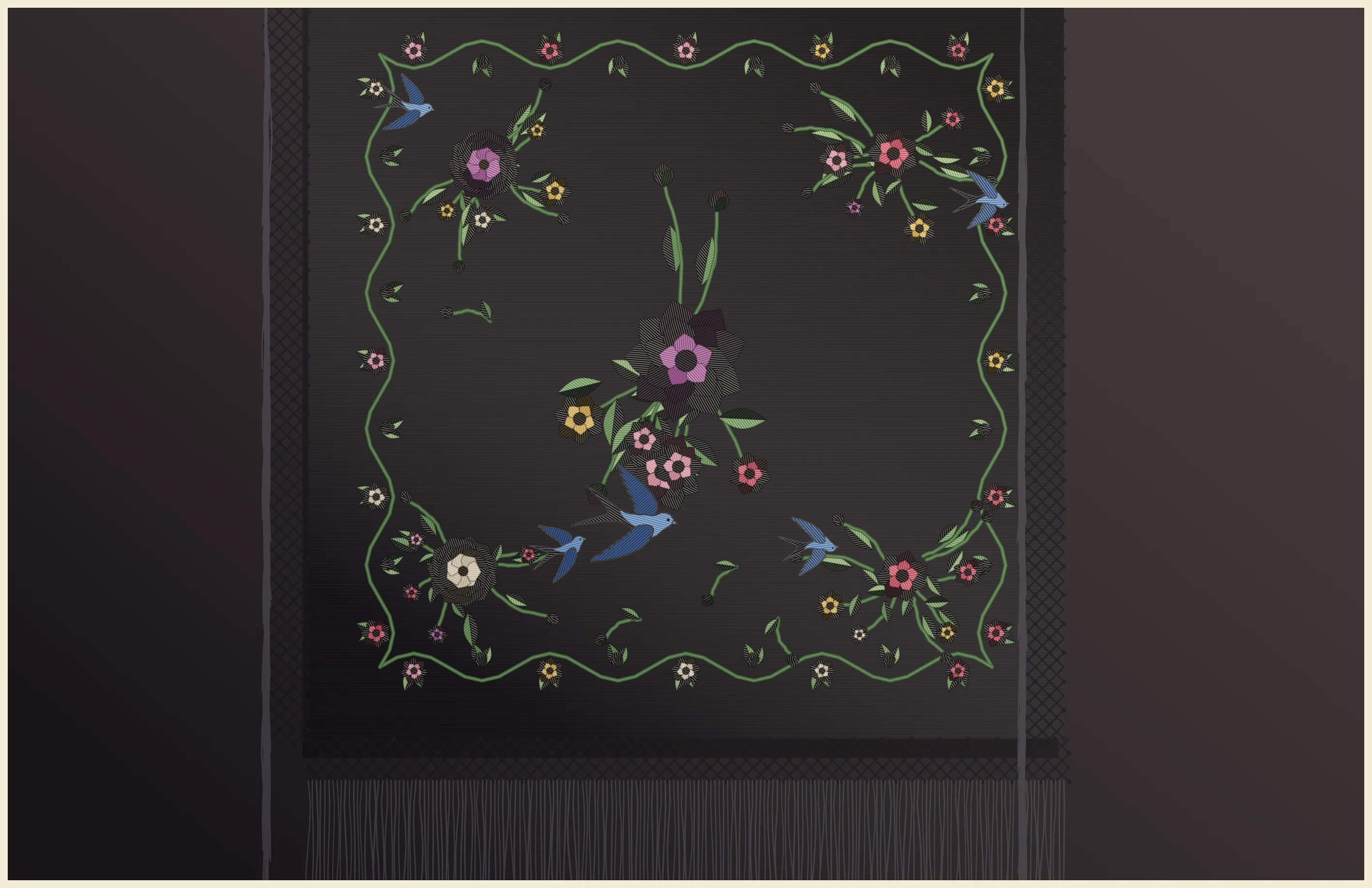
Mantón de Manila, the feria preset. Every petal is satin stitch with a direction, and the direction is what the light sees.
Rejería
Every window in Seville and Córdoba has a reja, and the balconies have grilles. Bars, rails, a frieze of scrolls along the rail, rivets where the bars pass through, and a twist in each bar where the smith heated it and turned it. The repeat is one-dimensional. A frieze is one motif set out once per bay and going on for ever, with a rosette every few bays, and the bars are the other direction’s repeat. The two together are the whole grille.
The motifs are all one function. A scroll is a bar that leaves a root along a heading and winds in, tightening as it goes:
function scroll(rx, ry, heading, R, turns, sense) {
  const cx = rx + R * Math.cos(heading + sense * Math.PI / 2);
  const cy = ry + R * Math.sin(heading + sense * Math.PI / 2);
  const a0 = Math.atan2(ry - cy, rx - cx), pts = [];
  for (let i = 0; i <= 40; i++) {
    const t = i / 40, phi = t * turns * TAU, r = R * (1 - 0.72 * t * t - 0.1 * t);
    pts.push([cx + r * Math.cos(a0 + sense * phi), cy + r * Math.sin(a0 + sense * phi)]);
  }
  return pts;
}
Two of those from a root at the middle of a bay’s edge, one heading up and one down, is a C. Two from the bay’s centre heading opposite ways with the same sense is an S. Two from the bottom point heading up and outward and curling in at the top is a heart, and from the same point curling the other way, with a bar between, a lyre. The rosette is a ring with eight of them radiating, alternately turning.
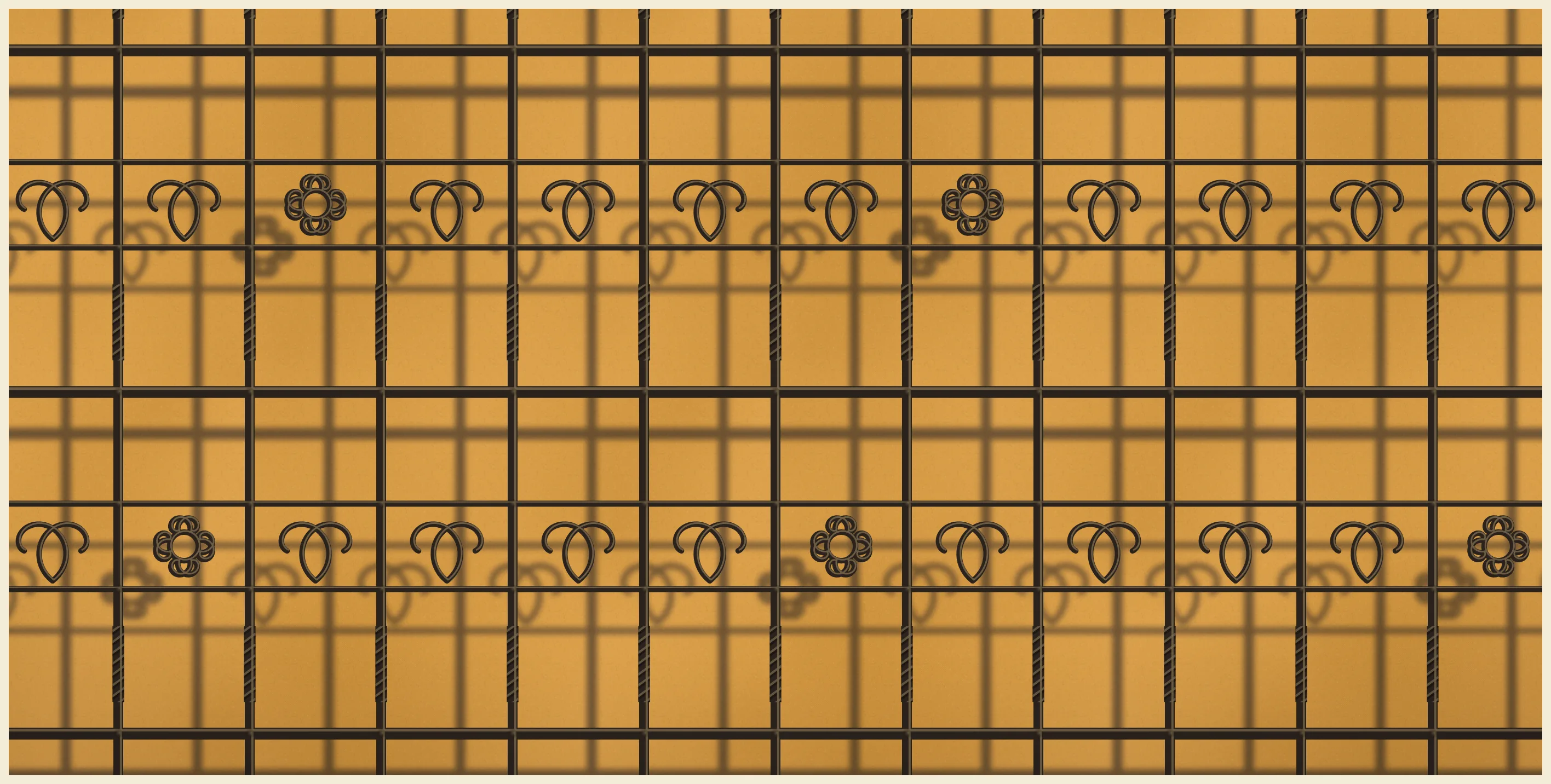
The córdoba preset. Hearts along the rail, an ochre patio wall, the sun low at half past five.
The grille is one path
The piece is the shadow. The grille stands off the wall by a distance you set, from a finger’s width to half a bay, and the sun is Sebka’s sun: along the wall from the left at six, in front at one, along it to the right at eight. Everything the grille is made of, the rectangles of bars and rails, the polylines of scrolls, the discs of rivets, is one path. It is drawn once in the sky’s shade colour onto a layer, moved along the sun’s slant by the stand-off, blurred in proportion to the stand-off, and multiplied onto the wall. Then it is drawn again in iron, with a highlight down the side toward the sun, which is the only lighting the iron gets.
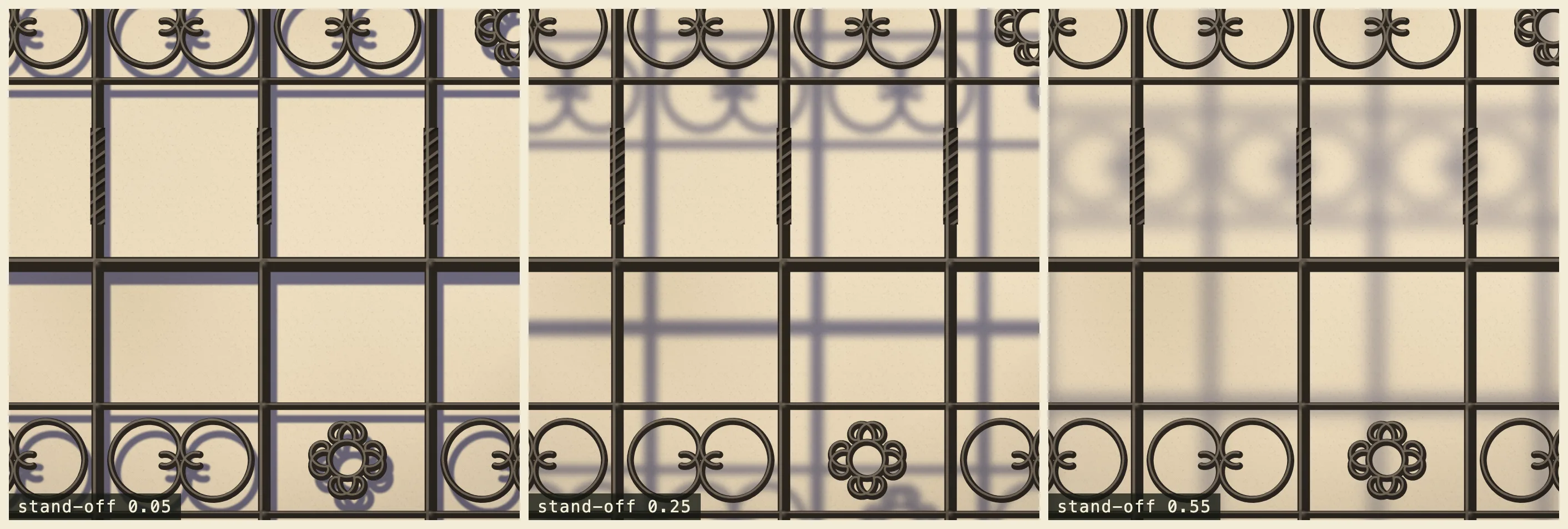
The sevilla preset at three stand-offs. The geometry and the sun are the same; only the gap between iron and wall changes.
That is the whole trick and it took one afternoon, which is what a rule you already have should cost. The second afternoon went on the iron being iron: the twist drawn as alternating lit and dark stripes clipped to the bar, the rivets as domes lit on the sun’s side, gilt on the scroll tips for the cathedral preset, and rust running down the lime from under every rivet when age is on.
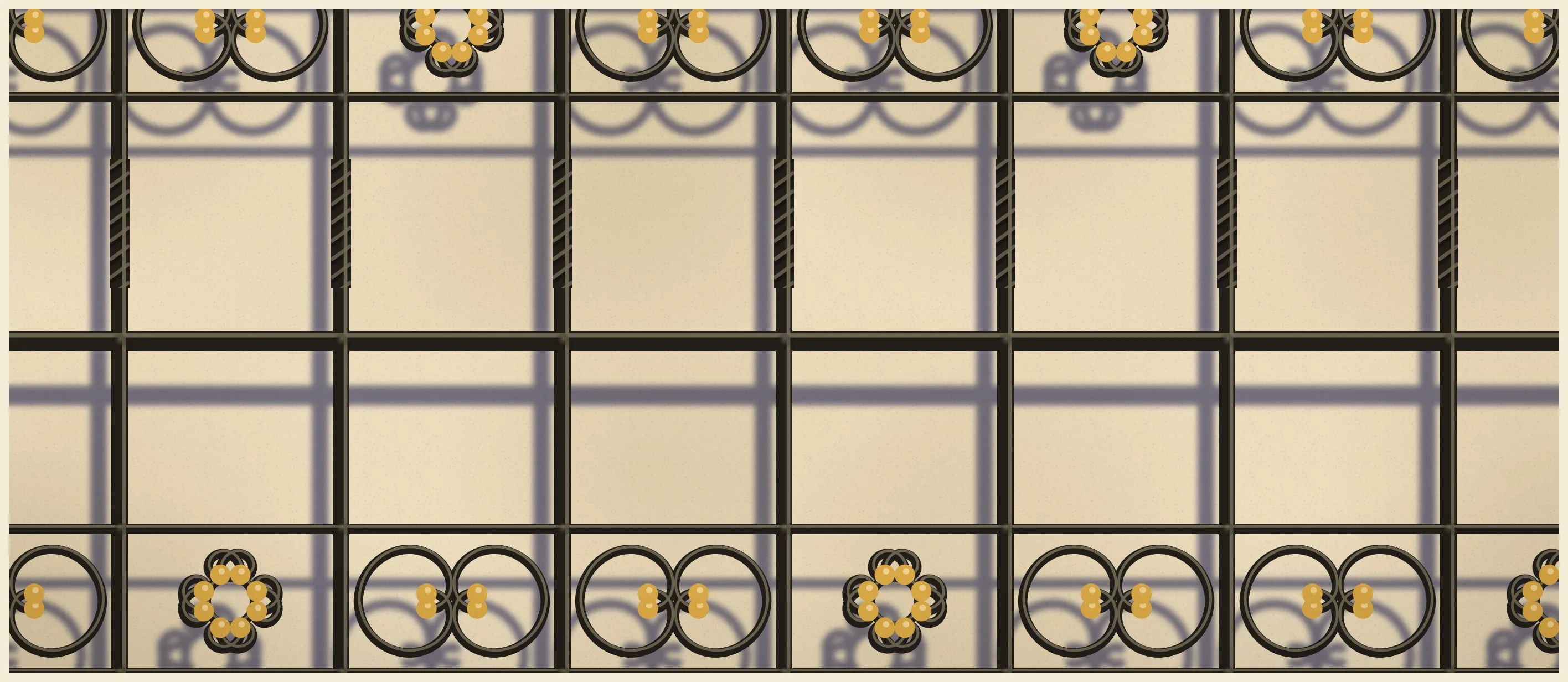
The catedral preset, up close. Black iron and gilt on the tips of the scrolls, after the big rejas of Seville cathedral.
Mantón de Manila
The shawl of the feria is a square of silk, black or cream or red, embroidered edge to edge with roses, peonies, leaves and the odd bird, finished with a knotted net and a long fringe. It came from Canton by way of Manila on the galleon to Seville, and Seville made it its own.
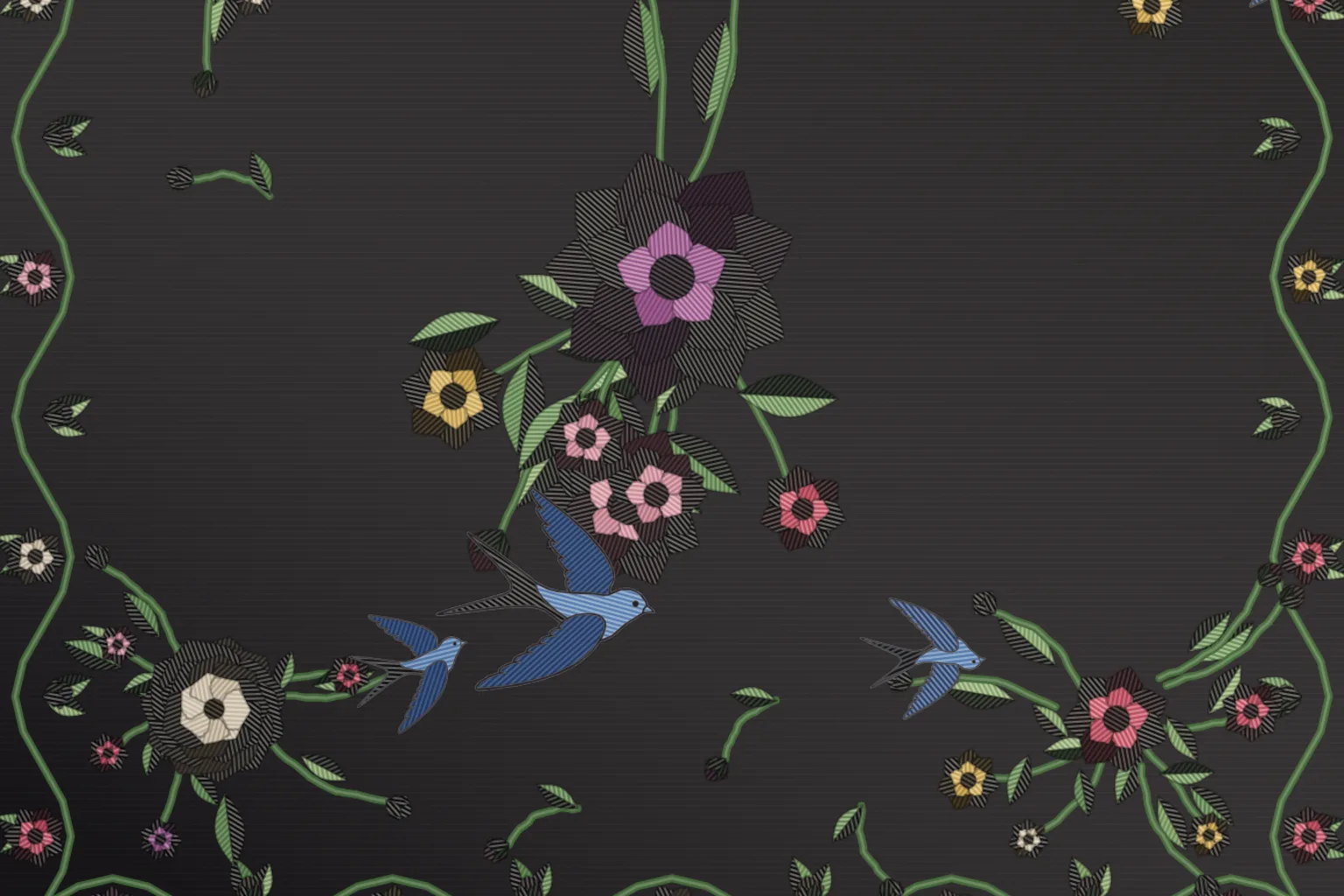
The material is thread. Satin stitch lays silk side by side in one direction across a shape, and silk shines where the light falls across the thread rather than along it. So every shape in the embroidery carries one number beyond its outline and colour: the angle its stitches run at. A petal is stitched from the centre outward, so its direction is its angle round the flower. A leaf is two halves, each stitched at an angle to the midrib, so the two faces never shine together. The swallow is traced from a flat drawing, the way Fajalauza’s bird was, and its body, wings and tail are each stitched along their own line. The brightness of a shape is how far its stitch angle is from the light:
const lit = (d, L) => Math.abs(Math.sin(d - L));
Nothing is shaded by hand. The fill is the thread’s colour pulled toward its dark face by how little it is lit, and over it the threads themselves are drawn, lines along the stitch direction with a shine between them whose strength is that same number. Turn the light slider and the roses light up petal by petal as each one’s angle comes round, and the leaves swap which half is bright.
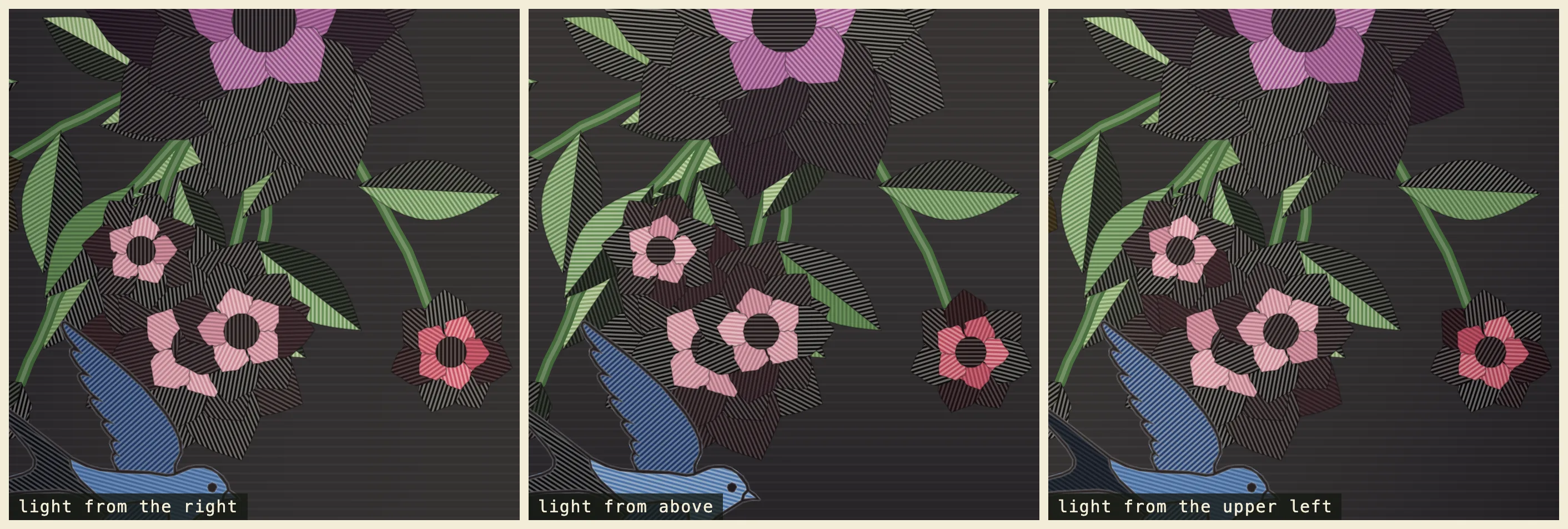
The same bouquet under three lights. The petals that shine are the ones whose stitches run across the light.
Black on black
A mourning shawl is black silk embroidered in black, and it is the best test of the idea, because colour cannot help. The luto preset turns the sheen all the way up and gives every thread the same near-black. The flowers are there only because their stitches run in different directions from the silk and from each other.
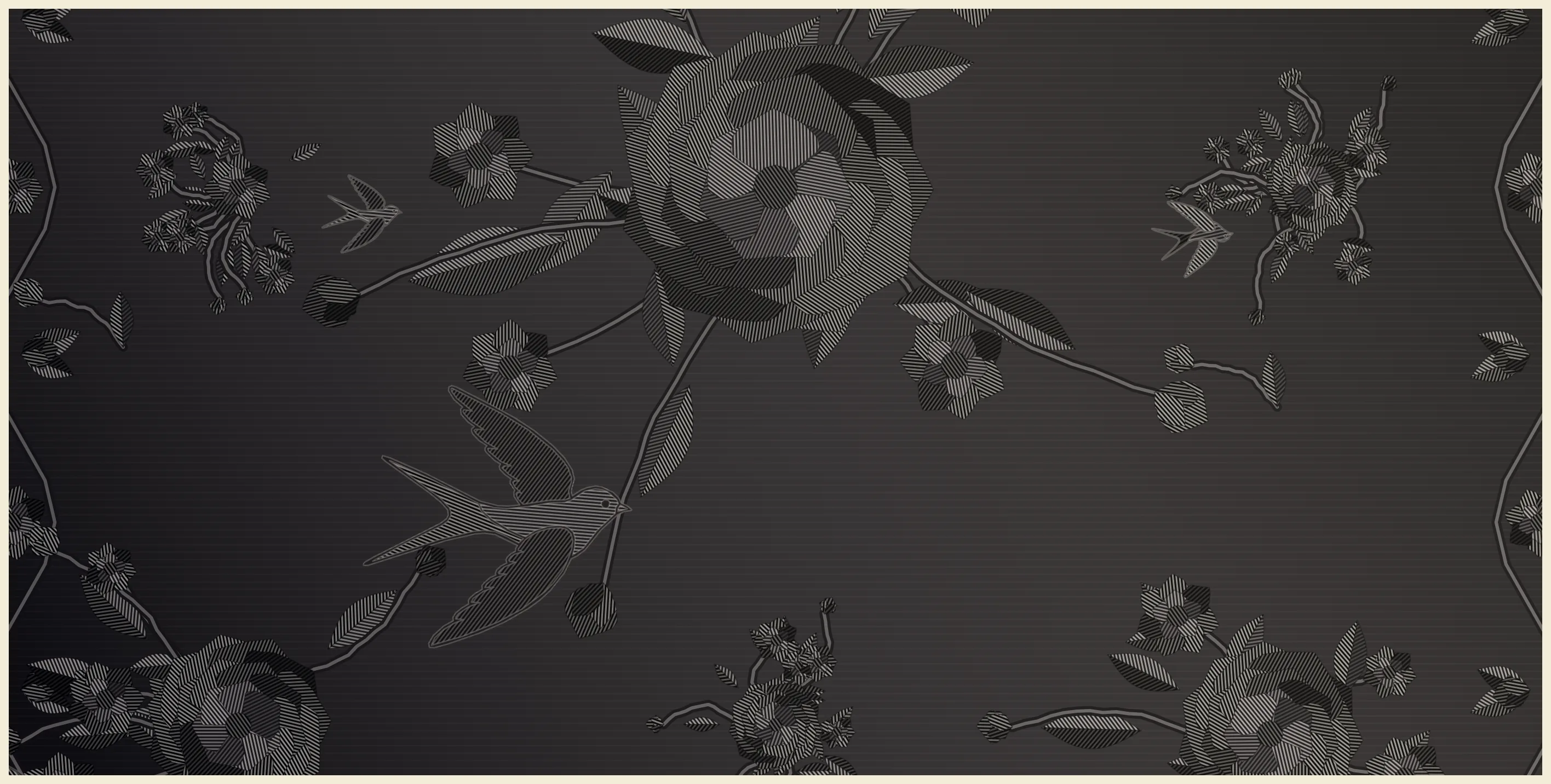
The luto preset. No colour at all; every shape is told from the ground by the angle of its thread.
The silk itself gets a broad shine along the light’s direction and a weave of fine lines across it. The shawl hangs from a rail along its top edge, with its shadow on the wall behind, so the knotted net and the fringe fall down the sides and below. Each thread of the fringe is its own line with a wave in it, lit by the same rule, which for a hanging thread means it shines when the light is from the side.
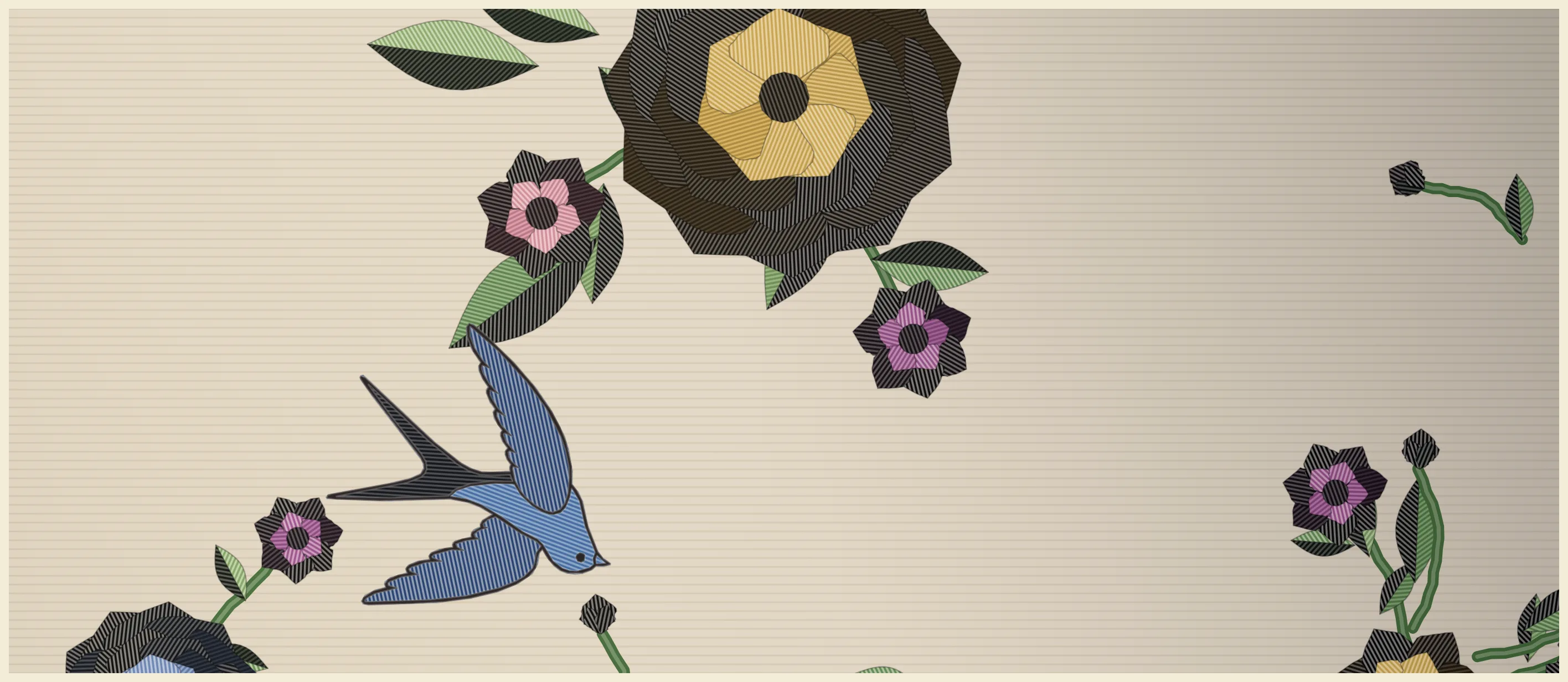
The tarde preset on cream silk with the light low from the left. The dark outer petals and the bright inner ones are the same colour pair at different angles.
What the two share
Rejería has no lighting model beyond a highlight; the sun’s whole job is to move a shadow. The mantón has no shadows beyond the one the shawl throws on the wall; the light’s whole job is to pick which threads shine. Both pages are the same shape underneath: a geometry built once from a seed, a light that is one angle, and a rule that turns the angle into what you see. Sebka had three heights and a slant. Rejería has one height and a slant. The mantón has no heights at all, just a direction per stitch. The sheen pass is the thing this one leaves behind, and it will come back the next time a page needs metal to catch the light.