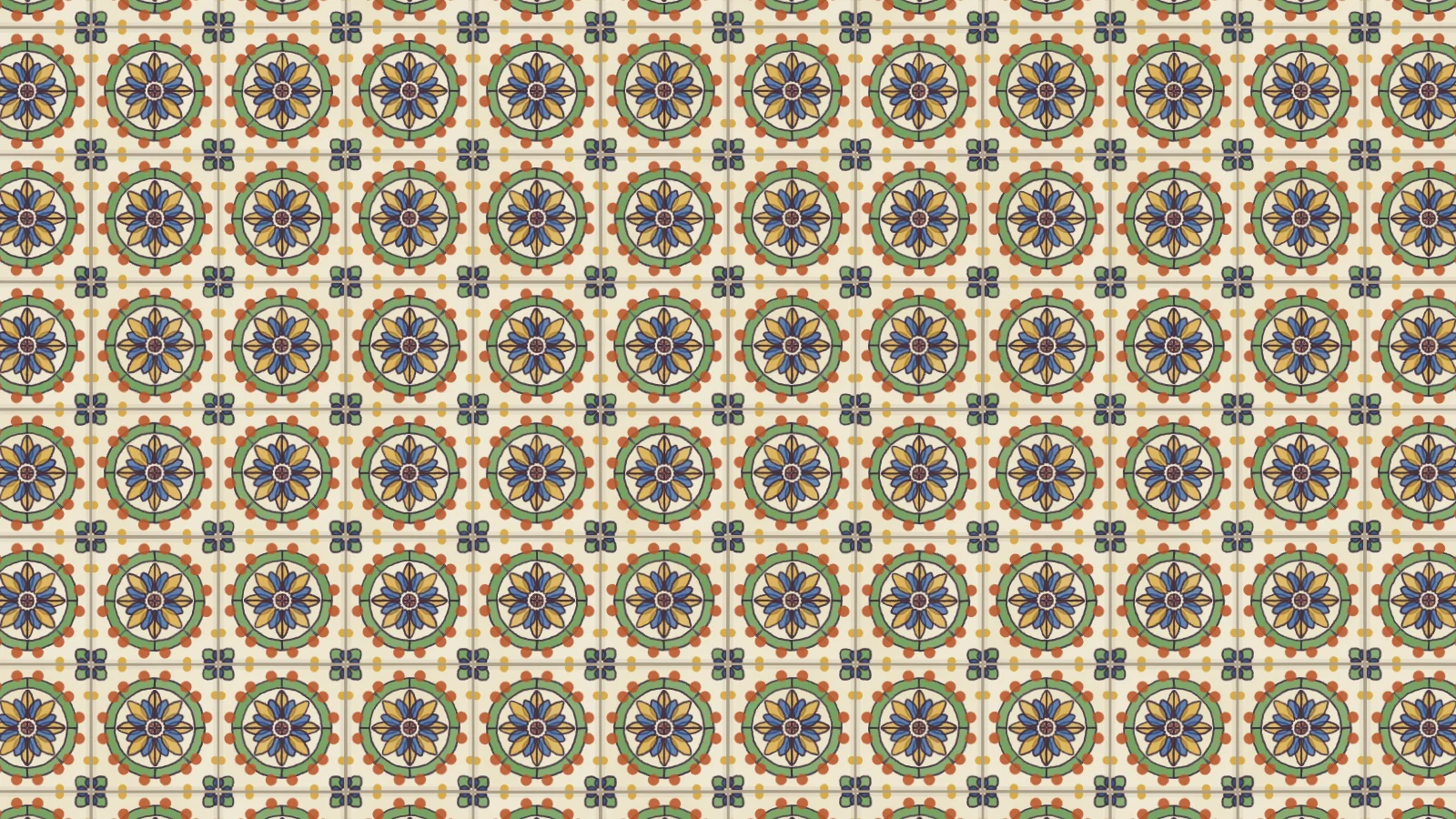
The tile pages on this site grow their designs from a seed: Azulejería, Jerez, Hidráulico and the others each turn a number into a rosette or a vine and lay it across a wall. Octavo has no seed. You draw the design in one triangle, and the wall does what it does on the other pages: it mirrors the drawing, turns it and lays it out.
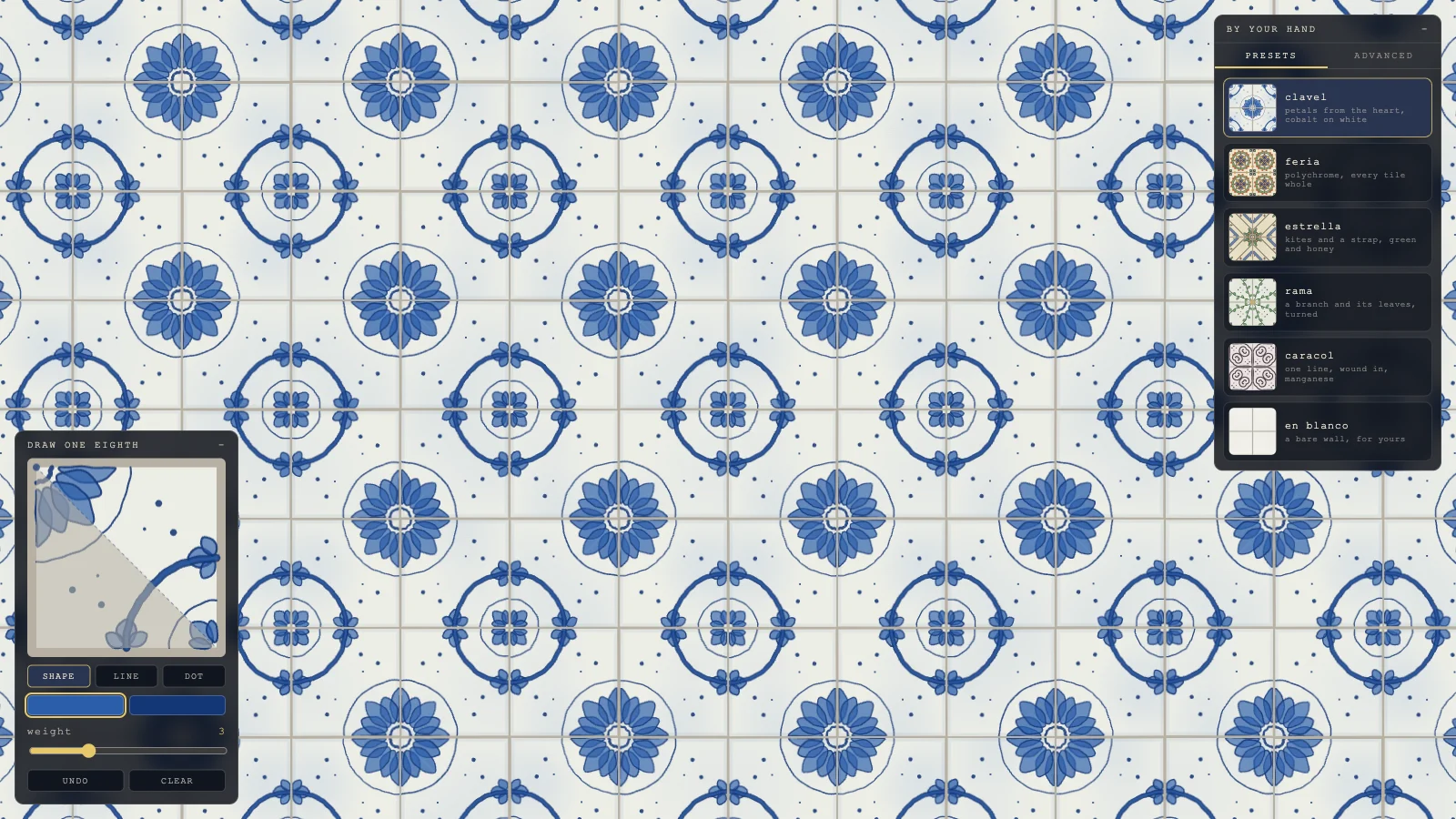
Octavo with its carnation preset. The pad at the bottom left is the square of the design: the bright triangle is the part that was drawn, the dimmed one its reflection.
Why an eighth
Every design the engine paints sits in a square and is symmetric across that square's diagonal. That symmetry is what lets four tiles meet at a corner and close a rosette between them, which the first post about the engine covers. Under the “single” repeat the square is a quarter of the tile, laid four times about the centre, so the half of the square on one side of the diagonal is an eighth of the tile. Octavo is the Spanish for an eighth. Under the four-tile module the square is the whole tile, and the triangle is an eighth of the four tiles together.
The pad shows the square. The bright half is where you draw, and the dimmed half shows the reflection. The corner with the dot is the heart of the design, which is the centre of the tile under “single” and the corner where four tiles meet under the module.
Three tools
A shape is a closed outline, filled with a wash and then inked round the edge. A line is ink, or in any other colour a ribbon with an ink edge. A dot is a dot. There is a weight slider, an undo and a clear, and the colours on offer are the palette's own: the wash, up to three accents and the ink.
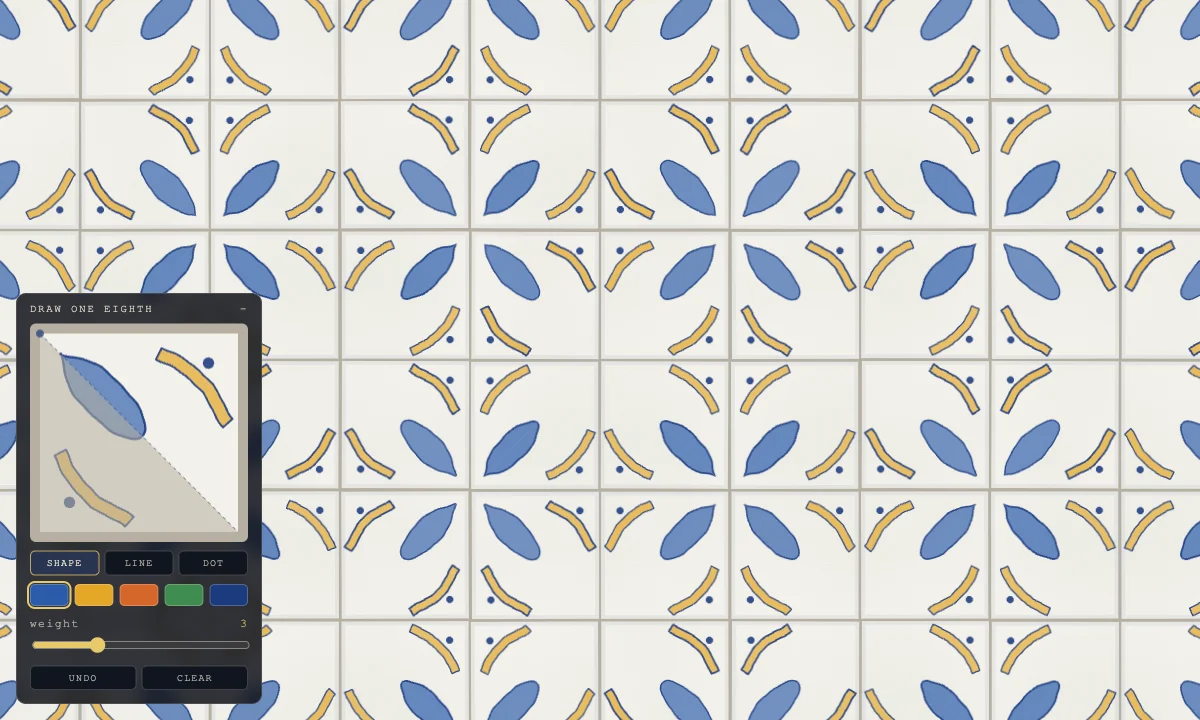
Three strokes on a bare wall: a shape drawn across the diagonal, a ribbon and a dot. The ribbon was drawn on the dimmed side and reflected over.
A stroke drawn on the dimmed side is reflected onto the bright side when you lift the pen. A stroke that crosses the diagonal is cut there, and the part beyond the cut is replaced by the reflection of the part before it, so a petal drawn roughly across the diagonal comes out symmetric.
The wall repaints several times a second while the pen is moving, so you see the repeat form as you draw.
What happens to a stroke
The path the pointer leaves is simplified until it has at most 96 points, and that is what gets stored. When it is painted, its corners are cut three times to make a curve, and it is given the slow sideways drift that every brushstroke in the engine has, scaled by the hand slider. My first version drifted each short segment of the stroke separately. That looked fine on screen and ragged at print size, so the drift now runs along the whole stroke from end to end.
Glaze is translucent, and two translucent halves that meet on a line leave a hairline there, because their soft edges overlap and come out lighter or darker than the fill. Octavo paints each half on a layer of its own, clipped exactly at the diagonal, and adds the two layers together. Where the two edges share a pixel their coverage sums to one, and the join does not show.
The drawing is in the address
A drawing is stored as a short string: one byte for the version, two bytes of header for each stroke (its kind, colour, weight and number of points) and two bytes for each point. The three strokes in the picture above come to 39 characters. The carnation at the top of this post is 14 strokes and 122 points, which is 364 characters.
The page keeps that string in its address as ?d=, with the palette and the repeat beside it, so a wall can be sent to someone as a link. The “copy the link” button in the advanced tab does that. Two bytes a point puts every point on a grid of 255 steps, which is about 0.6 mm on a 15 cm tile.
The presets are drawings in the same format, written out as the points a hand would have left.
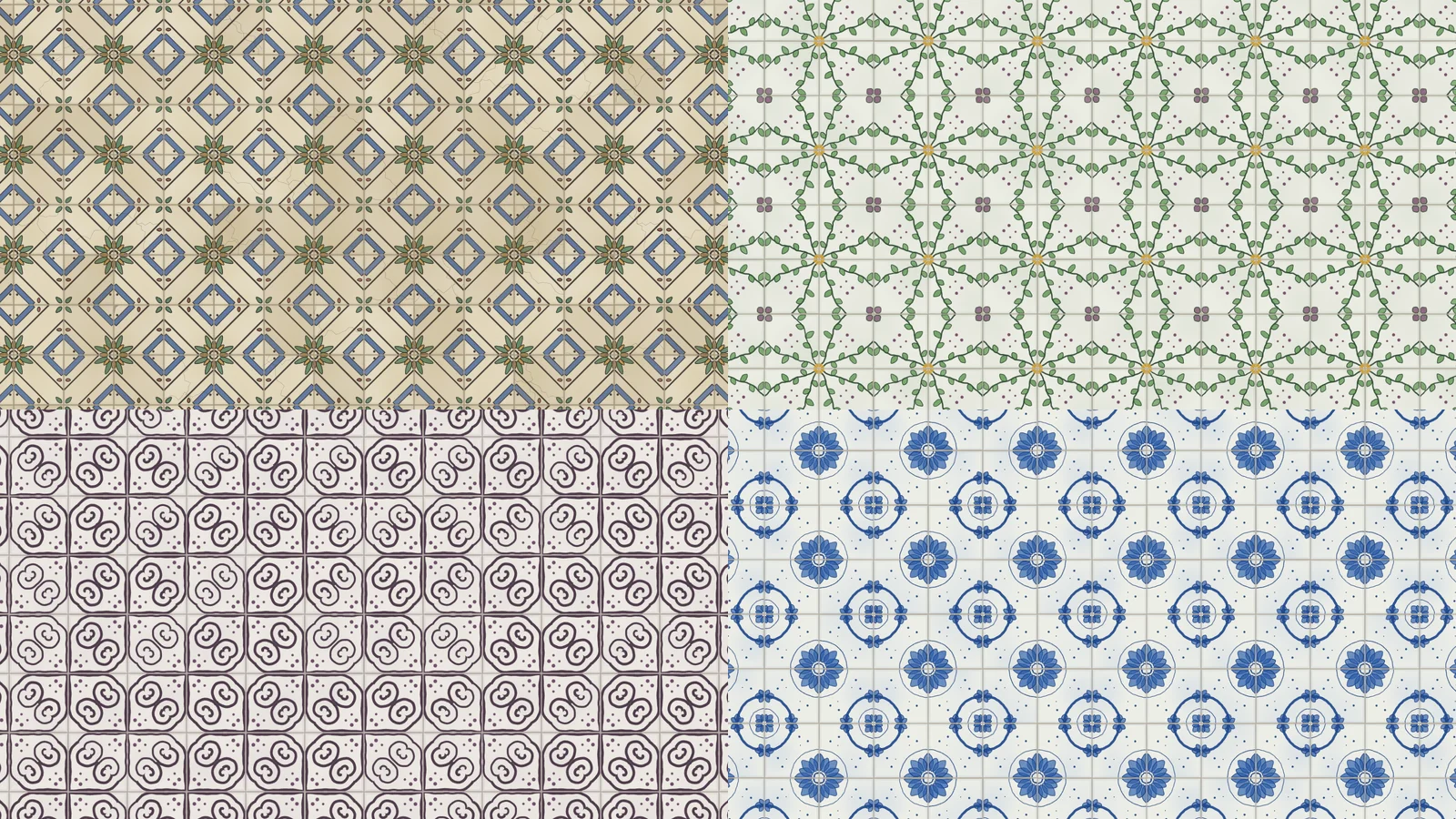
Four of the presets: estrella, rama, caracol and clavel. Each is a drawing of between five and fourteen strokes.
One tile at print size
The “tile for print” button, also in the advanced tab, paints one tile at 15 cm and 300 dpi and saves it as a PNG. The tile is painted again from the design at that size, not scaled up from the screen. It is 1772 pixels across, with a 3 mm bleed on every side, 1842 pixels in all. The bleed is the tile mirrored outward past each edge, which is exactly what the neighbouring tile is under the four-tile module and an approximation under the other repeats. The file records its own resolution, so it opens at 15.6 cm.
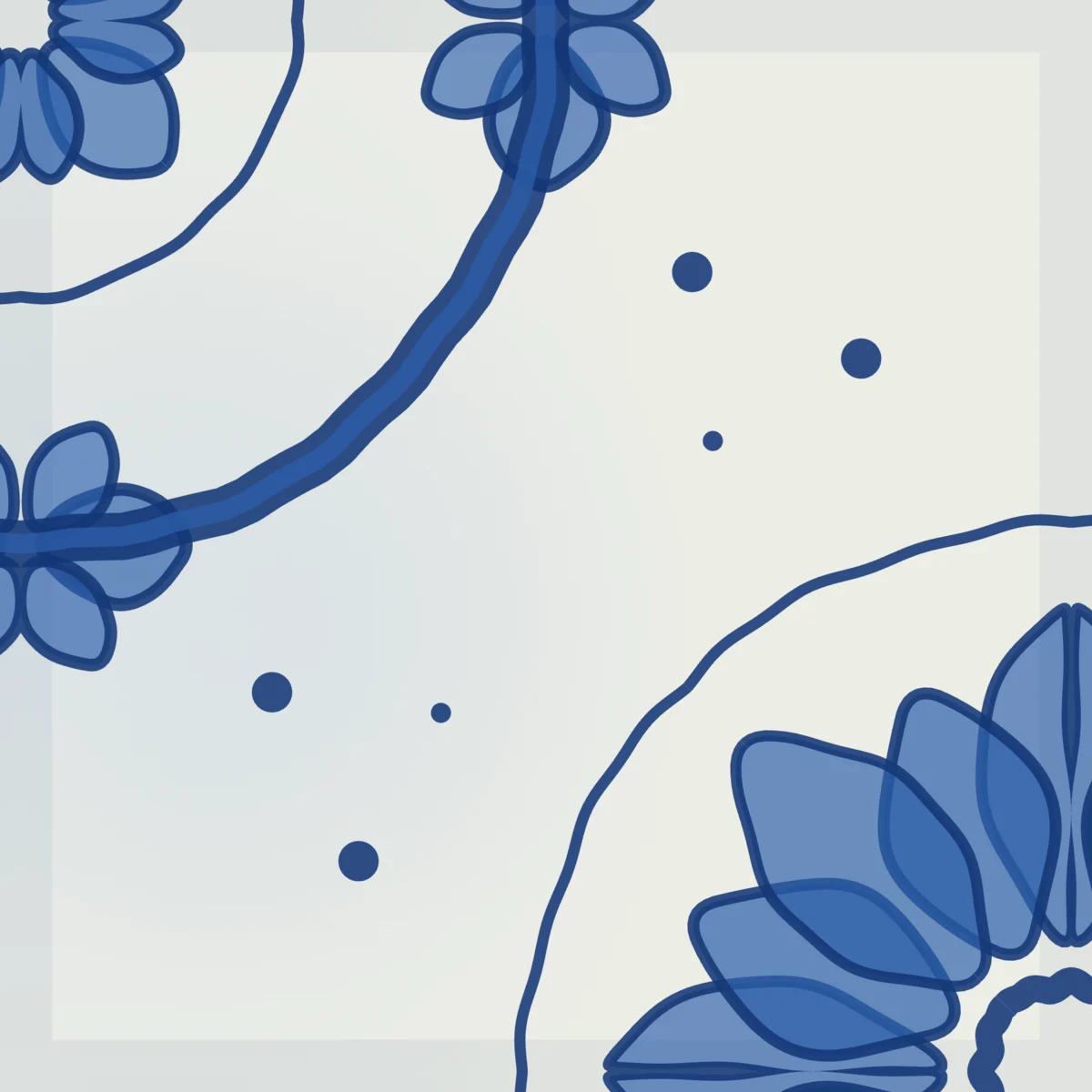
The carnation tile as the print button saves it, reduced here. The design runs on into the 3 mm bleed at the edges.
The button is on Octavo and on eight other pages: Azulejería, Jerez, Hidráulico, Fajalauza, Rosa y Granada, Encaustic, Delft and Papel Pintado, where what it saves is the printing block. Age is left off the printed tile, and a checker wall saves its painted tile.
If you know someone with a tile printer or a kiln, this is the file to send them. I have not had a tile made from one yet, so I can't say how the colours fire. The page offers one size. The function behind it, exportTile, takes the size, the resolution and the bleed as options.
In the package
All of this is in azulejeria 2.6.0. The azulejeria/draw module has the encoding, the motif, the stroke painter and the pad, and exportTile is in the main module. A wall you can draw on is the usual createWall with drawnMotif() as its motif, followed by mountPad(wall). The pad paints with whatever material the wall has, so the same drawing could be pressed in clay or poured in cement. Octavo itself is glaze only.
There is no eraser and no way to move a stroke once it is drawn. Undo takes strokes off in the order they went on.