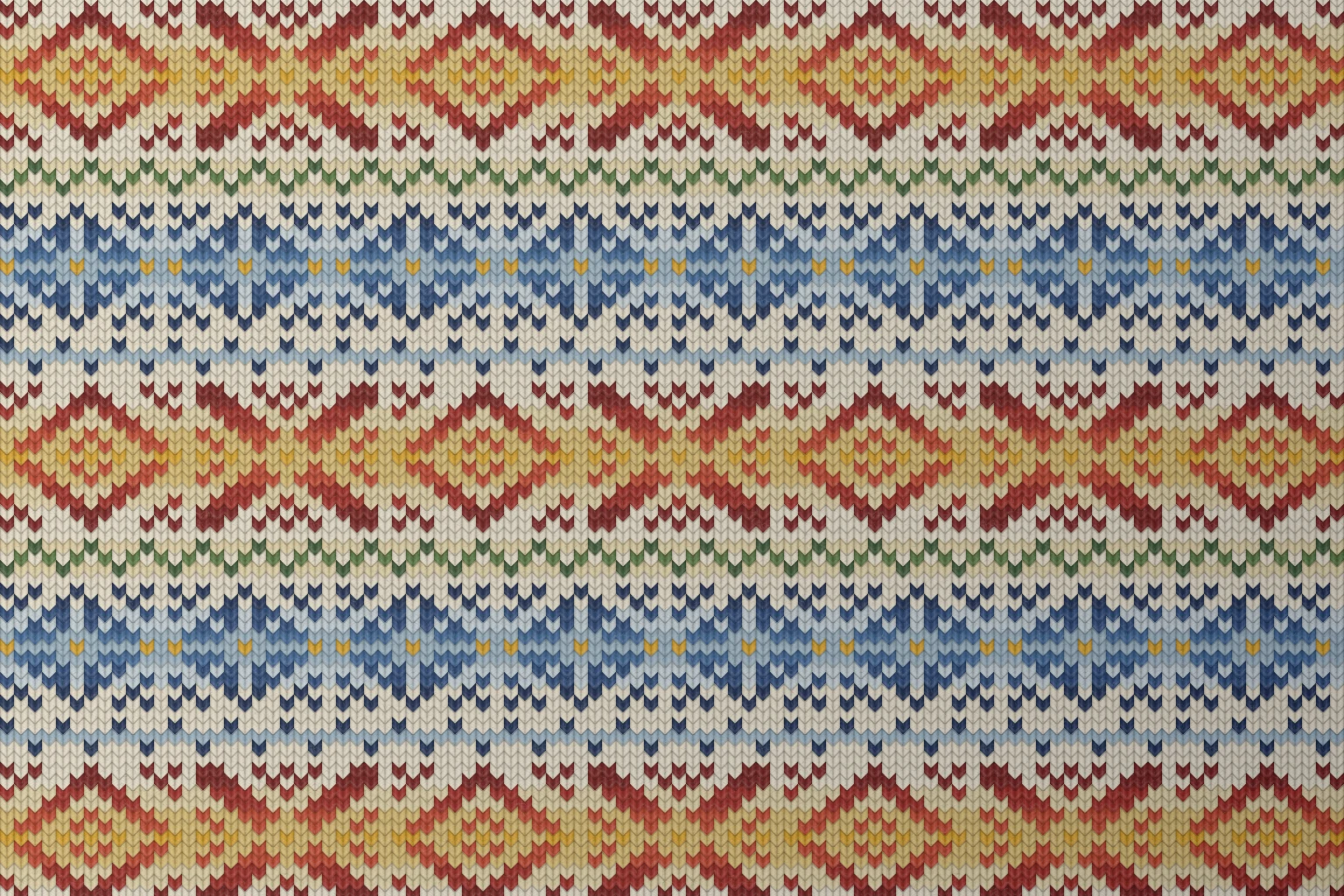
Fair Isle is the newest pattern piece, and the second made of cloth after Tartan. It is stranded knitting from Shetland: bands of small repeating motifs, two colours in every row, the colours changing every few rows. You pick a cloth or write one as a line of text, and the page knits it for as far as you care to drag.
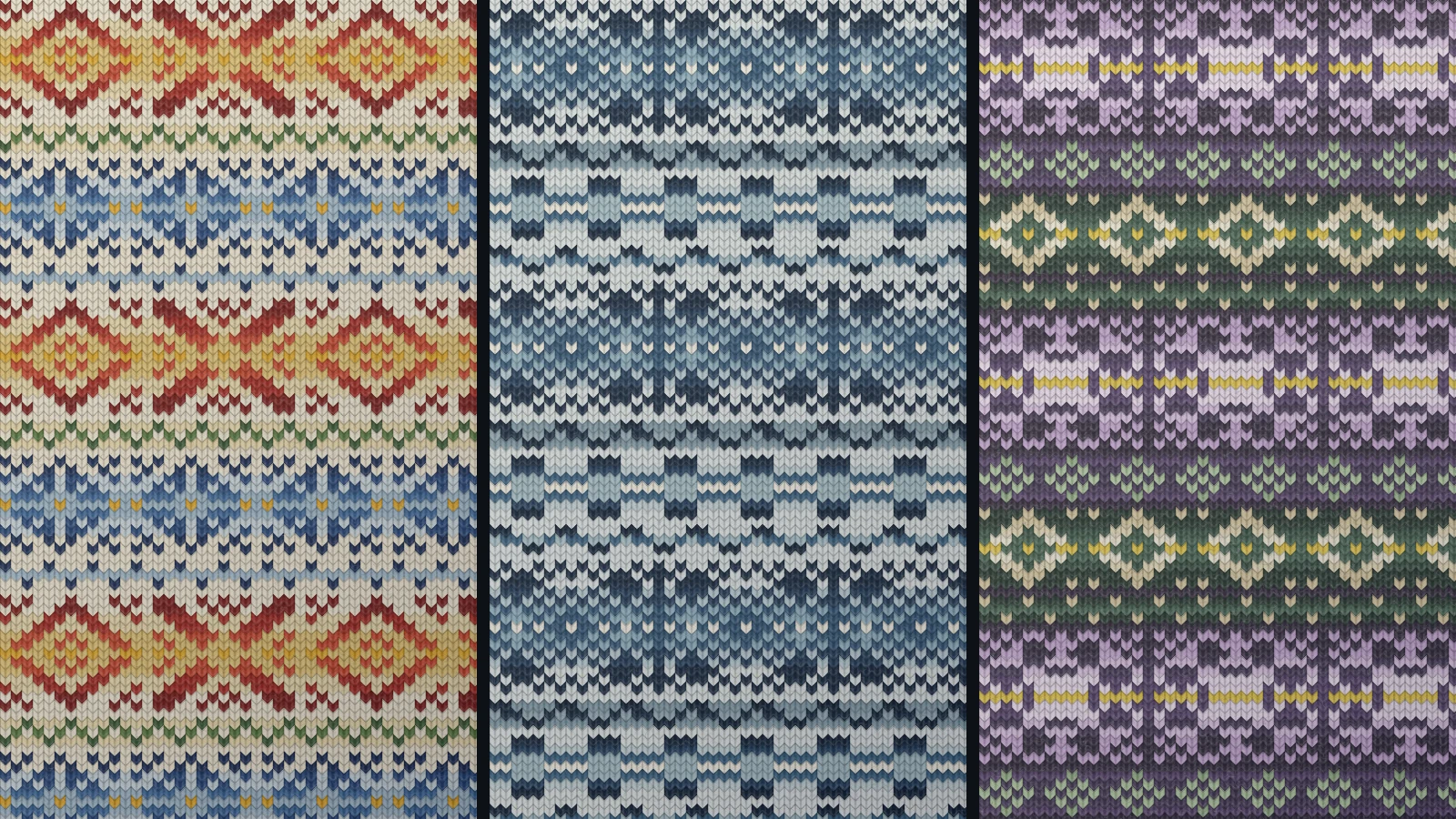
Three of the presets: madder and indigo, sea, and heather. Each is a few bands repeated down the cloth.
A cloth is a stack of bands
Fair Isle is the southernmost island of Shetland, about halfway to Orkney, and this way of knitting is named after it. The cloth is built in horizontal bands. The wide ones are a dozen or so rows of a large motif. Between them are narrow bands of one to five rows that Shetland calls peeries, peerie being the word for small. Each band is one small chart repeated all the way round the body.
The page writes a cloth as its bands from the top down. The first preset is oxo13 zig star11 seed: the O and the X over thirteen rows, a three-row zigzag, a star over eleven rows and a three-row scatter of single stitches. With a plain row after each band that comes to 34 rows, and then the cloth starts again. A wide band takes its number of rows after its name, any odd number from 7 to 21. There are five wide bands (oxo, star, diamond, flake and tile) and ten peeries, and the advanced tab lists them when its text box is empty. The text goes in the address as ?bands=, so a cloth can be sent as a link.
A chart is drawn on squared paper, one square for each stitch. In the code it is a list of strings, with a dot for the ground and an X for the pattern. This one is zig:
..X.
.X.X
X...
The wide bands aren't typed out. Each is a rule on how far a stitch is from the middle of the motif, across and up, so the same rule gives the band at 7 rows or at 21, and every motif has the eight symmetries of a square. The O is the stitches whose two distances add up to the half-width or one less, with smaller rings inside it. The snow crystal should have six arms and has eight, because eight is what a square grid gives.
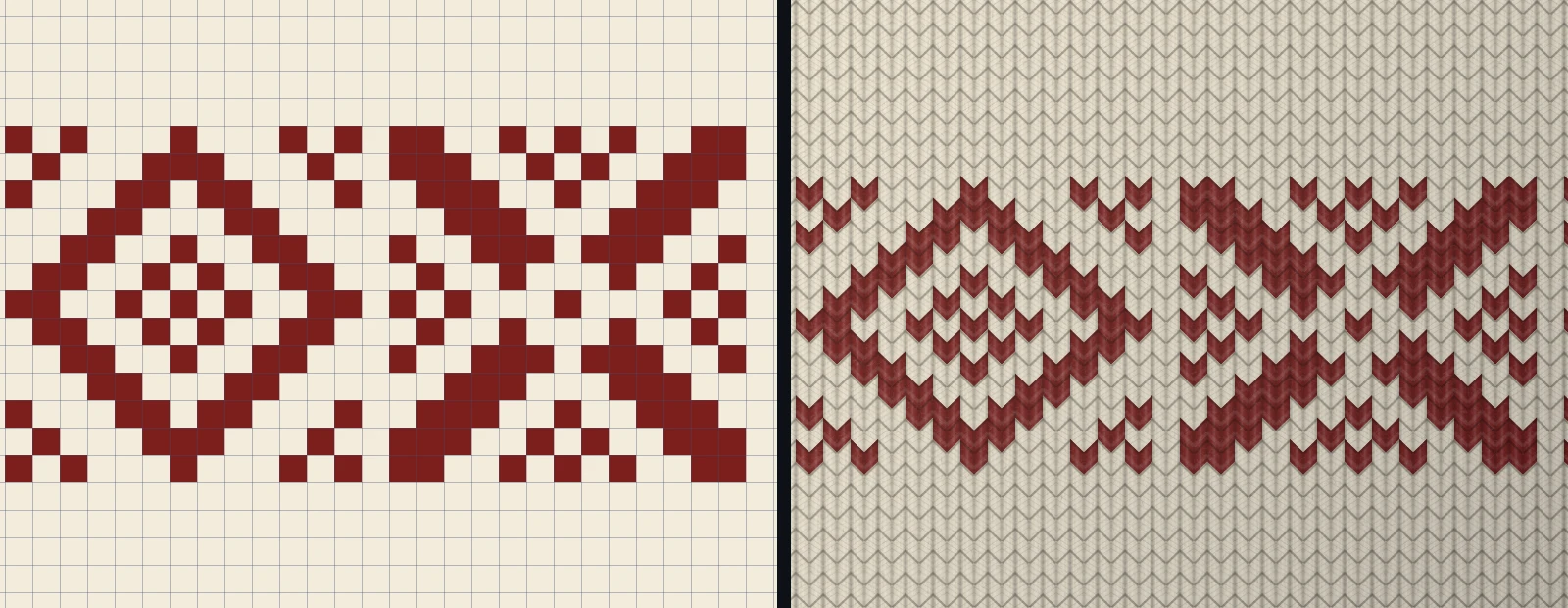
The O and the X at thirteen rows: the chart, 27 stitches wide, and the same chart knitted in two flat colours.
Two colours a row, and nowhere far to carry them
Two rules separate Fair Isle from other colourwork. The first is that a row has two colours and no more. The knitter carries both along the row, often one in each hand, and knits each stitch with whichever colour the chart asks for.
The second rule follows from the first. The colour that isn't being knitted runs loose across the back of the cloth until it is wanted again. That loose strand is called a float, and a long float catches a finger every time the jumper goes on. The usual advice is to keep a float to about an inch. The page's limit is seven stitches.
A star thirteen rows high is thirteen stitches wide, and its top row has a single stitch of pattern. Knitted on its own, that row would leave the pattern colour floating behind thirteen stitches of ground. So no Fair Isle motif stands alone on its ground, and the corners between two stars always have something in them.
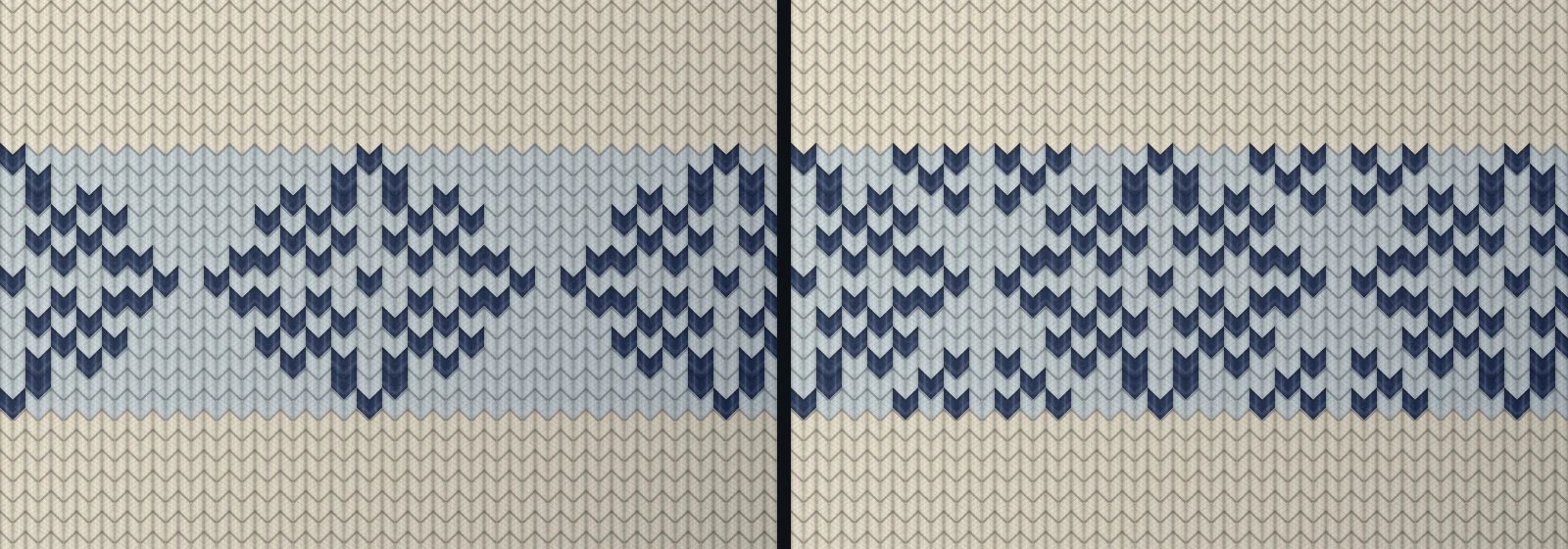
The thirteen-row star as its bare shape, with floats of up to 13 stitches, and with its corners filled until none is longer than 7.
The module fills the corners the same way. Every wide band starts as its bare shape, and floatsOf measures the longest float as the chart repeats, counting across the join between one repeat and the next. If the float is over seven, rings of alternate stitches are added in the corners, where four motifs meet, and at the middle of each side. The rings grow one step at a time and stop as soon as the longest float is seven or less, so a band gets no more filling than it needs. The thirteen-row star goes from a longest float of 13 to one of 7.
Under the text box the page prints the longest float of the cloth you have written. The tests check both rules for every peerie, and for every wide band at every height from 7 to 21 rows. They also knit a cloth in each of the six wools and count the colours in every row.
The colours change on every row
Two colours a row says nothing about which two. Both can change on any row, and in Fair Isle they do. Here the ground and the pattern each step through a few shades from the edge of a band to its middle row and back. In the middle row of a wide band the pattern is knitted in one bright colour that the wool uses nowhere else.
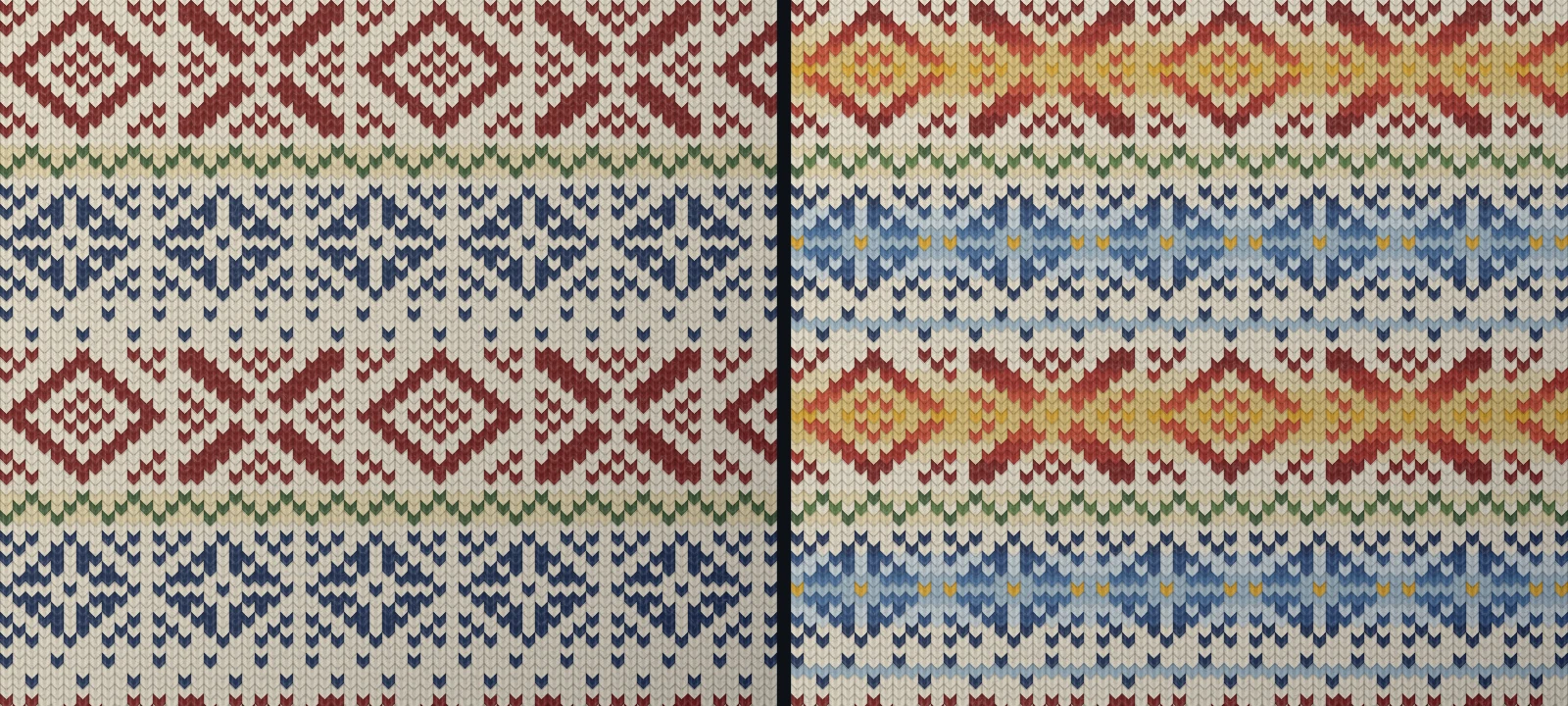
The first preset with shading off and on. The pattern is the same stitch for stitch.
Each wool on the page is a dye lot: a base colour for the plain rows, the bright colour for the middle row, and three sets of shades, each with a run for the ground and a run for the pattern. The wide bands take the sets in turn, which is why the O and the X come out in madder red on gold and the star below them in indigo. “Shade each band” in the advanced tab turns the stepping off, and the cloth goes flat.
There are six wools: madder, undyed Shetland, sea, heather, yule and this site's own colours. The names describe the colours and aren't dyers' records. The motifs were made by rule on squared paper, and none was copied from a pattern book.
Every stitch is a V
Fair Isle is knitted in the round, so the knitter only ever makes knit stitches, and from the front each one is a V. A column of stitches is a stack of chevrons. Where the colour changes along a row the edge is a zigzag, and where it changes between rows the points of one colour hang down into the next.
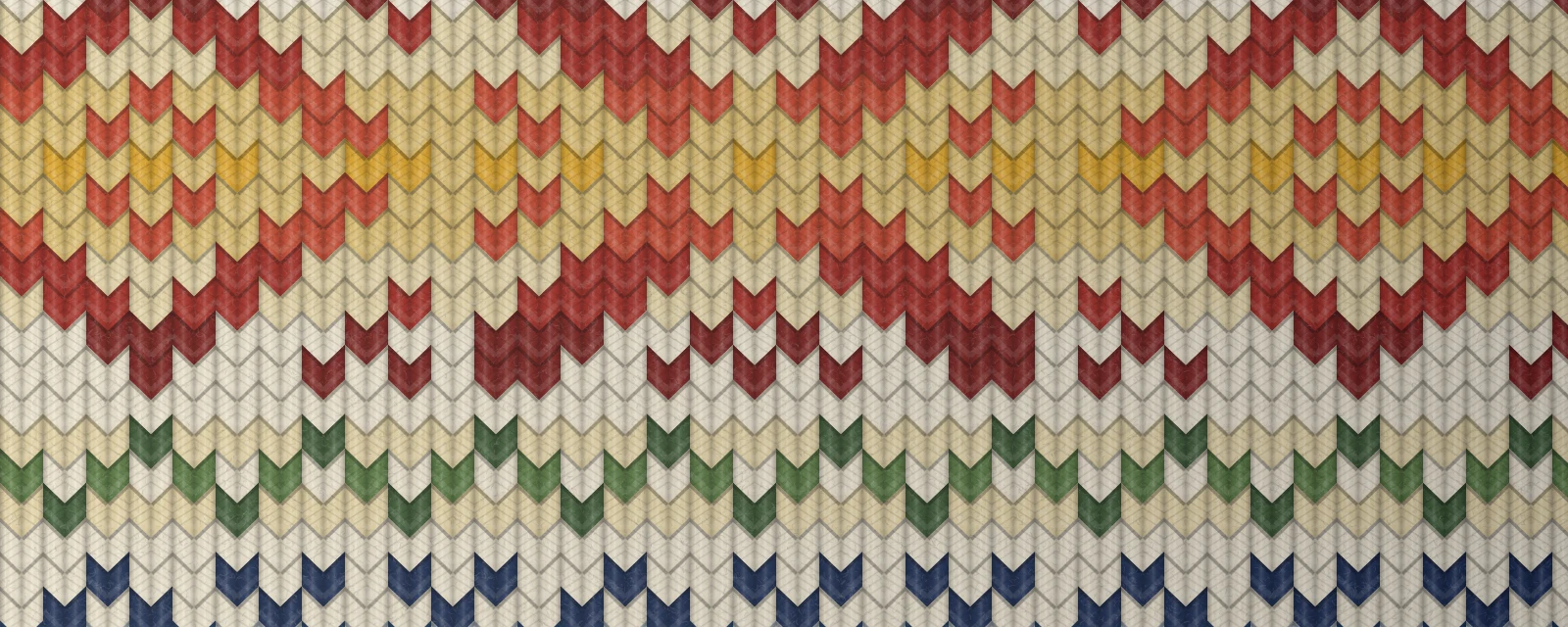
The first preset at 44 pixels a stitch.
paintKnit draws exactly that. A stitch is one unit wide and 0.8 high, and the point of the V hangs 0.6 of a row below its shoulders. A stitch is wider than it is tall, which is why the chart on squared paper further up comes out squatter in wool. A run of one colour along a row is drawn as a single shape, with the zigzag along its top and the same zigzag along its bottom. Over the colour goes one small tile of shading, repeated for every stitch: each leg of the V is round across its width and dark where it tucks under the row above, with the slant of the plies across it. Last comes a tile of loose fibres for the halo of the wool, which the “halo” slider fades.
My first version put every run of a colour into one path for the whole cloth, and filling that path took 2.3 seconds at five pixels a stitch. Filling the same shapes six rows at a time takes about 150 milliseconds. Below four pixels a stitch the Vs aren't drawn, and the cloth is painted at one pixel a stitch and scaled up.
Bands nobody charted
A ? in the text is a wide band made from the seed. The module makes two short strings of random bits. It reads one by the sum of a stitch's two distances from the middle and the other by their difference, which is reading along the two diagonals. A stitch is in the pattern where the two bits disagree. Reading along diagonals gives lozenges and saltires, the shapes the big Fair Isle bands are made of. The module tries up to sixty pairs of strings and keeps the first whose longest float is seven or less. For the forty seeds and three heights in the tests, it always finds one.
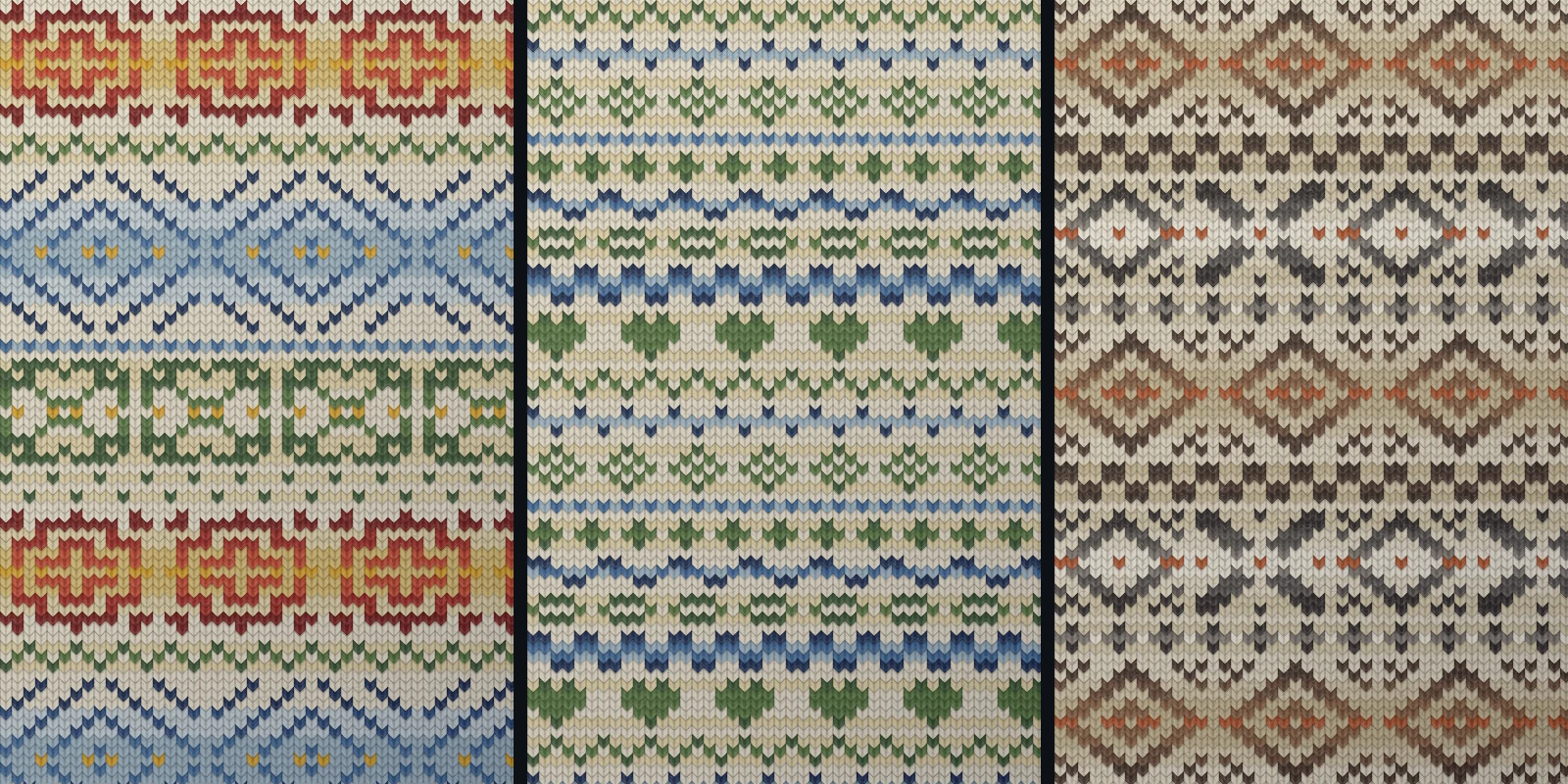
By rule (three bands from the seed 2026), peeries only, and naturals.
The “by rule” preset is three of these bands with peeries between them. The double tap writes a new cloth: two to four wide bands, some charted and some not, each followed by a peerie or two.
A real jumper has things the page doesn't. There is no corrugated ribbing, no steek (the extra stitches that are cut open for the armholes) and no yoke that narrows towards the neck.
In the package
The knitting is azulejeria/knit, new in azulejeria 2.8.0. Charts, bands, the float check and knitPixels, which fills a cloth at one pixel a stitch, need no page, so their tests run in Node, as the loom's do.